A Radio Experience
Tales from the early days of KUSH
By David Shanks
I write this thinking somebody might actually be interested in this narrative, or at least find it mildly amusing. On the other hand, if one has never participated in or even thought about what might go on behind the scenes in a small radio station in the fifties, I have wasted your time and mine!
During this idyllic period of Americana, radio still reigned supreme, although TV was gaining ground quickly. I watched and listened to the likes of Arthur Godfrey, Bob Hope, and Groucho Marx, all of whom had announcers with deep, golden voices. My fascination may have been about their ability to earn a substantial living and enjoy some stardom by simply reading something. I could read, and my pronunciation seemed okay, at least according to my Mother, the English teacher. I also noted that these guys were pretty good at ad libbing as well; how hard could that be? Anyway, I decided around age 13 or 14 that my life’s work would be as a radio announcer.
Other than writing and directing some student skits to entertain fellow classmates, I could find little creative outlet for this burning desire; but the local radio station recently constructed by a Mr. William Howard Payne in Cushing, Oklahoma, cleverly called KWHP…get it? Now the studios for this 1,000 watt giant were out in the country, along with the transmitter and tower – and a goldfish pond. I know not why a goldfish pond, but that is where I found Mr. Payne as I sought employment. While enjoying an afternoon cocktail (or two or three), he quickly assured me that my voice was too “sophomoric” to grace the airwaves around Cushing. He told me to “come back in a few years.”
In a year or so, the station changed hands, as well as call letters, now KUSH, Voice of the Cimarron! The Cimarron, by the way, is a muddy, often dry, river that meandered through the area. If it had a voice, then I was still determined to be it! The new owners were also publishers of the local paper in the nearby community of Drumright, where I lived, along with my family and friends. Because of this, and maybe because of my willingness to work for a dollar an hour – weekends and evenings, I was suddenly qualified.
The station went through a number of station managers and daytime announcers, all colorful characters, but my mentor became Clayton Vaughn. Clayton was a local Cushing boy, who had tried his hand at higher education and fraternity life at the University of Oklahoma, but for reasons unknown to me, it didn’t work out. Clayton DID have a great radio voice, a devilish sense of humor, and an ego to fill a much larger radio station! In addition to Program Director duties (I never quite knew what that meant) he did the daily afternoon shift, selecting and playing records, reading the news and commercials, and bantering as if someone was listening. The show had a name of course, “Spins and Needles”…oh so fifties! It was Clayton who was to teach me the ropes.
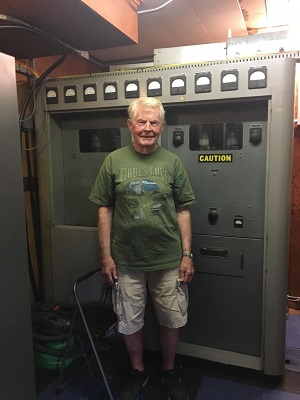
Now I am far removed from the radio station environment of today. I know that it consists of large corporate multi-station owners, and very sophisticated technology, but this is a far cry from KUSH back in the day in Central, Oklahoma. In the evenings and weekends at least I was alone, left to turn the transmitter on and off, take all sorts of meter readings, cue up and play records (mostly 45 rpm, by the way), scramble to tear off a five minute newscast from the AP teletype every hour, and then read it as if I knew what I was talking about. That always gave my every-listening mother a few embarrassing moments.
Recorded commercials were maintained on small reels of magnetic tape in numbered sequence, one reel for each client. Juggling dozens of reels, and six reel-to-reel tape machines, with seconds to find and cue the right message, was a challenge. Suffice it to say that things did not always work out. Clayton, in fact, did little to teach me. I always suspected that his social life took on immense importance the minute his shift was over, as he tarried rarely, except on a few occasions when his goal was to cause me to go bananas whilst on the air. Trial by fire was the order of the day. The screw-ups were legendary! The station maintained an old disk recording machine from the days before tape. The recording needle actually laid down groves on what I think was an acetate disk. The by-product was what was called “angel hair” – highly flammable stuff that curled up in immense black balls as the machine worked its magic. Flammable is relevant here, as Clayton casually lit the stuff, tossed it into the airtight control room as I was reading the news, and watched the putrid black smoke fill my lungs! Missing a step on the air was secondary to trying to put out the fire.
As the months and years wore on, even summers during my college years, I gained a wealth of experience in sounding like I knew what I was talking about…certainly a life skill for someone destined to be a professional sales person. And of course, improvisation, tornado alerts for example. Although a daylight station only, special dispensation from the FCC allowed us to remain on the air in the event of an evening tornado alert, of which there were many. After all, Central Oklahoma was and is “tornado alley.” On occasion, this was exciting enough for Clayton to remain at his post as his shift was over and I took control. Clayton, with a microphone in hand, and a six pack of beer, would mount the roof and scan the skies. This was the only “radar” available to the hundreds of folks crouched in their cellar, clinging to their radio. Because of these antics, I harbor a skeptical view of “on the scene” newscasters, even today!
We had a few national advertisers who provided pre recorded commercials for which only a live tag was required. For example, once a week I was the “Pepsi Cola Silver Dollar Man” – phoning folks randomly and giving away money to a lucky listener. Our business was mostly local, however. Thus, it became a part of our job to create and record (on tape of course) announcements promoting our local customer base…cars, furniture, drug stores, etc. Coming in after hours to accomplish this (in varying states of sobriety), added to the creative process. Some of these had only an airing lifetime of once – after the sponsor heard it on the air!
Returning to this job off and on during college recess kept my hand in and one summer served as a way to communicate with a girlfriend in Tulsa my arrival time for our date that evening. All in code, of course, and not always clear; a thousand watts didn’t carry very far on most days.
Few calls came in from New York or Hollywood. My only touch with celebrity was one evening when a young Country and Western singer and her manager stopped by the station to promote her latest record. That was the norm back then, as disk jockeys could make or break a new release, and we were certainly in “country and western” territory. The very young teenage girl was none other than Loretta Lynn…who knew?
During this era television was growing quickly in popularity – possibly expanding opportunities for my budding broadcasting career. I gave the radio and television broadcasting major a go at Oklahoma University, but it wasn’t to be. I caved in to much higher starting salaries in Engineering and went back to Oklahoma State in Stillwater. My days on the airwaves were over. Live, over the air broadcast, without a script and no second chances, remains a fun memory for me. As I watch all these good looking men and women on TV today, I ponder what might have been. My small town radio days taught me to think on my feet and stood me in good stead. I have no regrets!
After graduating from OSU, David spent a couple of years in the military and went on to have a successful business career until retiring almost 20 years ago. He and his wife Anita live in California.



![[Your] News](https://www.1600kush.com/wp-content/uploads/2019/02/sidebar_yournews.jpg)