

Media release
Celebrating Public Power Week 2024, October 6-12
(Grand River Dam Authority) — Each year, the American Public Power Association (APPA) sets aside the first full week in October to recognize the many benefits that public power utilities provide to homes, businesses, and communities all across the country.
Public power is comprised of more than 2,000 publicly owned, publicly controlled electric utilities in the United States, like the one right here in Cushing. Collectively, these utilities provide abundant, reliable and competitively priced electricity to over 54 million Americans in 49 states. They are all not-for-profit and community focused, existing to meet the needs of their customer-owners while providing all the benefits that can only be found in a public power community.
But as Public Power Week 2024 arrives again, many may be wondering how public power first came to Cushing. Here is a brief history …
Back in 1912, long before public power arrived in town, the city granted its first electricity franchise to the Cushing Electric Light & Power (CELP) Company. That private company was actually owned by some Cushing citizens. Customers could enjoy electric lights in their home for a maximum rate of ten cents per kilowatt-hour. Electricity was still considered a rare and expensive luxury at the time, with less than 30 percent of American households being electrified. However, there were enough customers to make the business successful.
By 1918, as the “luxury” of electricity continued to grow in popularity, CELP caught the eye of out of state interests. That year, the power company and its franchise rights were sold to Minnesota Light & Power Company (MLPC), headquartered in Minneapolis. MLPC owned and operated the electricity plant and system in Cushing for the next ten years, until selling out to the Interstate Power Company (IPC) of Dubuque, Iowa.
It was also around this time that the citizens of Cushing began to discuss the possibility of a municipally owned, locally controlled power plant. In other words, public power. In fact, momentum grew so strong for public power that a bond issue was passed to fund the construction of a modern street lighting system that would be owned by the city and the citizens of Cushing. It was after the Cushing Board of Commissioners gave instructions to begin the preparation for plans for a municipal power plant that the five-year path toward Cushing public power regally began.
IPC was opposed to the idea of municipal ownership and spent time and money to stop it, but Cushing’s future as a public power utility would not be denied. On March 7, 1935, the Oklahoma Attorney General J. Berry King approved the bonds that would finance the construction of the new municipally owned power plant. Ten months later, the new plant was in operation and Cushing was a public power community, with local control and local, not-for-profit ownership of the electric distribution system.
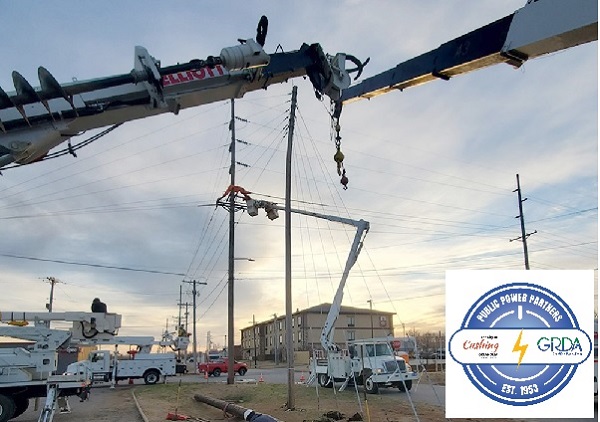
Even today, the city still maintains its own electric generation. However, in 1953, to meet the electric demands of a growing community, Cushing became a public power partner of the Grand River Dam Authority (GRDA). Ever since, GRDA has supplied wholesale electricity to Cushing and helped support the City of Cushing’s efforts to provide all the benefits of public power to Cushing residents.
The public power model works like this: the City of Cushing buys wholesale GRDA electricity and then resells it at retail rates to end-users in the community. Revenues generated from that process are then used to operate and maintain the municipally owned electric system and to help fund other city services, like police and fire, parks, and streets. These dollars stay at home, in Cushing, where they help to enhance the quality of life, making the community a wonderful place to live, work and play.
Nine decades ago, the citizens of Cushing had a vision for the future and voted to establish a public power legacy. Today, that legacy lives on for all those who live, work, and play in the community.
![[Your] News](https://www.1600kush.com/wp-content/uploads/2019/02/sidebar_yournews.jpg)